There’s a particular kind of discomfort that comes with making a decision when you don’t know how it’s going to turn out.
You can think it through. Weigh the options. Ask people you trust. Make a list of pros and cons.
You can consider every possible outcome you can imagine.
And still, eventually, you have to choose without knowing what happens next.
I think that’s the part we sometimes struggle with most.
Not necessarily making the decision itself, but accepting that we can’t know in advance whether it will work out the way we hope.
What if I choose this and regret it?
What if the other option would have been better?
What if I’m missing something important?
What if I make the wrong choice?
Sometimes these are useful questions. There may be information we haven’t considered, consequences we need to think through, or people whose perspectives would help us.
But sometimes we’ve considered everything we reasonably can.
And we’re still waiting.
Waiting for a sign.
Waiting to feel certain.
Waiting for the moment when one option finally feels so obviously right that choosing it no longer feels like a risk.
I wonder how much of our lives we spend waiting for that feeling.
Because certainty can be awfully reassuring. If we could know that we were making the right decision, we could move forward without having to worry about what might happen if we weren’t.
We could choose without risking regret.
We could act without having to live with the possibility that things might not work out.
But that’s not quite how decisions work, is it?
We make them with the information we have, the circumstances we’re in, the resources available to us, and the understanding we’ve developed so far.
And then life continues.
New information arrives. Circumstances change. Other people make their own choices. Things we couldn’t have anticipated become relevant.
Sometimes our decisions work out beautifully.
Sometimes they don’t.
Sometimes we make a thoughtful decision and still get an outcome we never wanted.
And sometimes we make a decision that seemed right at the time and later realize we’d choose differently now.
I don’t think any of that necessarily means we failed to trust ourselves.
It means we made a decision without having access to the future.
Which is, unfortunately, the only kind of decision most of us get to make.
When I read tarot, I’m not trying to take someone’s uncertainty away by handing them a predetermined answer.
I’m more interested in the questions the cards help us ask.
What does this card bring to mind?
What does it invite you to consider?
Does it resonate with something you’re already sensing, or does it offer a perspective you hadn’t entertained?
Sometimes we need a different lens to notice something we couldn’t see from where we were standing. We might discover an influence we hadn’t considered, recognize a strength we haven’t thought to draw on, or begin to understand why we’re hesitating over something we otherwise want.
That’s what draws me to tarot and astrology. Not the promise of a predetermined future, but the opportunity to explore the patterns, possibilities and influences that might help us meet our lives more consciously.
A pattern can offer context without becoming a verdict. A possibility can be worth considering without becoming a promise. And something that resonates with us doesn’t have to dictate what we do next.
You don’t have to agree with every interpretation. You don’t have to treat a card as an instruction. And you certainly don’t have to hand your judgment over to it.
The reading is part of the conversation, not a replacement for your own voice.
My intention, when I read for someone, is to remind them of their own agency and empower them to take control of their own lives instead of putting their future in someone else’s hands.
We can seek perspective without seeking permission. We can take what feels useful, question what doesn’t, and decide what we want to do with what we’ve learned.
And then we still get to choose.
I think self-trust can get tangled up with the idea that we should be able to recognize the right choice when we see it.
That if we really knew ourselves, listened to our intuition, or thought things through properly, we’d be able to choose correctly.
But that puts an awful lot of responsibility on us to predict things we cannot possibly know.
And when the outcome isn’t what we wanted, it gives us a convenient reason to turn around and put ourselves on trial.
I should have known.
I knew better.
Why didn’t I listen to myself?
Sometimes, in retrospect, we can identify something we missed. We can recognize a warning sign we dismissed or information we didn’t have at the time.
That can be useful.
But there’s a difference between learning something from a decision and deciding we should have been able to predict everything that followed it.
We don’t get to make choices with hindsight.
We make them with what we know at the time.
And perhaps trusting ourselves means allowing that to be enough.
Not because our judgment is infallible.
Not because we will always choose well.
But because we can make a considered choice without demanding that it come with a guarantee.
We can listen to ourselves, seek information, acknowledge uncertainty, and decide what seems right given what we know.
And then we can meet what happens next.
If we learn something, we can take it into account.
If our circumstances change, we can reconsider.
If we discover that we want something different, we can change our minds.
We don’t have to defend every decision we’ve ever made just because we made it.
We don’t have to keep walking down a path simply to prove that choosing it was the right thing to do.
And we don’t have to interpret every unexpected outcome as evidence that we should never have trusted ourselves in the first place.
Sometimes a choice is right for the person we are, with the information we have, in the circumstances we’re navigating.
And later, we become someone with different information, different needs, or a different understanding of what matters.
We are allowed to respond to that.
I think there’s something freeing about separating self-trust from certainty.
Because if I can only trust myself when I know I’ll get things right, then my self-trust depends on something I can never guarantee.
But if I can trust myself to listen, consider, choose, learn, and respond, then I have somewhere to stand even when the outcome is uncertain.
I don’t need to know that everything will work out.
I don’t need to believe that the universe has arranged things in my favour.
I don’t need to find a sign that tells me which future I’m supposed to choose.
I can be curious about the possibilities without treating them as promises.
I can hope for a particular outcome without assuming it’s the only one I could live with.
I can be afraid of making the wrong choice and still make a choice.
And I can leave room for the possibility that I’ll learn something along the way.
Maybe self-trust isn’t the feeling that you’ve finally figured everything out.
Maybe it’s the willingness to participate in your own life even when you haven’t.
To make a decision without knowing how it ends.
To let yourself be a person who is learning rather than a person who is supposed to know.
To remember that the next choice you make doesn’t have to be perfect to be yours.
You don’t have to know how things will turn out to decide what to do next.
Sometimes you can simply make the best choice you can with what you know.
And trust yourself to meet what comes after.
Tag: Astrology
-
What Happens When You Don’t Rush the Answer?
I have a habit of wanting answers before I’ve really understood the question.
Sometimes it looks like researching something for hours.
Sometimes it looks like replaying the same conversation in my head, hoping I’ll finally arrive at the one perfect interpretation.
Sometimes it looks like trying to solve a feeling before I’ve allowed myself to experience it.
I think many of us mistake speed for clarity.
We assume that if we think hard enough, search long enough, or analyze carefully enough, certainty will eventually appear.
And when it doesn’t, we often conclude that we’re doing something wrong.
But I’ve been wondering if certainty isn’t always what we’re looking for.
Sometimes what we’re looking for is simply relief.
Relief from not knowing.
Relief from uncertainty.
Relief from sitting with a question that refuses to resolve on our timeline.
That relief can be tempting.
It can make us reach for the first answer that sounds convincing.
It can make us dismiss our own experience because someone else seems more certain.
It can make us mistake movement for progress.
But clarity has its own timing.
Some things become clearer because we solve them.
Others become clearer because we stop interrupting them.
I’ve noticed this in my own life more often lately.
When something feels unsettled, my instinct is still to push for resolution.
To figure it out.
To make sense of it.
To tie it into a neat conclusion before I move on.
I’m practicing something different now.
When I notice that urgency, I try to ask myself another question instead.
“What happens if I stay here a little longer?”
Not forever.
Not endlessly circling the same thoughts.
Just long enough to hear what I might have missed while I was rushing toward an answer.
Sometimes nothing happens.
Sometimes the question simply becomes quieter.
Sometimes the answer arrives in a completely different form than I expected.
And sometimes I realize I wasn’t actually looking for an answer at all.
I was looking for permission to trust what I already knew.
The older I get, the less interested I am in collecting perfect answers.
I’m becoming much more interested in asking honest questions.
Questions that don’t corner me.
Questions that don’t demand immediate certainty.
Questions that leave room for curiosity, contradiction, and change.
That’s part of what I’ve been building over these past few months.
Not a system for figuring yourself out.
A practice of staying in conversation with yourself.
It’s a quiet shift, but it has changed the way I relate to almost everything.
Instead of asking,
“How do I solve this?”
I’m learning to ask,
“What is this asking me to notice?”
Those two questions lead to very different places.
One assumes I am a problem to fix.
The other assumes I am a person worth listening to.
I know which one I’m trying to practice.
Slowly.
Imperfectly.
One honest question at a time.
I do not have to rush my own becoming. -
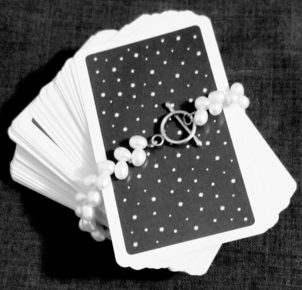
Pearl for May 27, 2021
Gemini and Sagittarius (Mutable Air and Mutable Fire respectively) are strong today—be on the alert for flightiness. It’s okay to not be grounded all of the time, but with the Fixed modality being particularly weak, we can harness our mental agility at this time to write out a wish list to enact when it’s the right time. Don’t get so caught up in fantasies and dreams that you never put them into action.